
Sell a House Before Foreclosure in Los Angeles
Behind on payments? Time matters. The sooner you look at your choices, the more of them you have. A sale may be one option. Still, it is important to talk with your loan servicer. It is just as important to ask a qualified housing or legal professional about all the choices open to you.
Tucker Buys Houses LA can talk with you about whether a direct sale fits your house and your timeline. If you searched for "sell house before foreclosure Los Angeles," this page lays out your choices in plain steps. To talk about selling before foreclosure, call (424) 341-0837.
SELL YOUR HOME IN 3 SIMPLE STEPS
Dozens of people just like you already have!

1. Contact Us By Filling The Form
Provide us with some basic info by filling out the form below. Once we receive your information, we figure out how much we can offer for your house and will contact you within 24 hours.

2. Receive Your Cash Offer
Whether you'd like to meet in person or just speak on the phone, we’ll give you our best, free no-obligation cash offer in writing or just verbally.

3. Pick A Closing Date
If you accept our offer, we can close in as little as 7 days! But if you need more time, we will work closely with you to make sure closing happens on your timeline.
YES, It's That Simple
WE WANT TO HELP!
Life is hard enough without having to worry about trying to sell your home. We'll do everything possible to make selling your home as convenient and stress-free as possible

FOR ANY SITUATION
Foreclosures
Divorce
Financial Struggles
Relocation

IN ANY CONDITION
Structural Damage
Unfinished Interiors
Hoarder Home
Major Repairs Needed
WITH ANY STRUGGLES
Code Violations
Low Equity
Bad Tenants
Late Mortgage Payments
5 Reasons To Work With Us:

NO REPAIRS
We'll gladly buy your home "as-is," in any condition.

WE DO ALL THE WORK
From paperwork to legal complexities, we've got it all covered

NO FEES
You won't pay fees or commissions of any kind.

CLOSE FAST
Close on your schedule and get cash in as little as a week.

LOCAL TITLE COMPANY
We close through a reputable title company in your market.
Selling Your House To Us = No Pressure or Stress
Want to sell your house fast in Los Angeles County but worried about dealing with a complicated process? We are reliable cash buyers who stick to our offers and make selling easy. Whether you are just curious about what a serious cash offer for your house looks like or if you are ready to sell, the offer is free and you are under no obligation to take it.
Sell My House Fast With Confidence!
Fill Out This Form To Get Your No-Obligation All Cash Offer Started!
Need to get in touch?
Los Angeles County Service Area
Choose your city for local information about selling your house as-is.
 Sell Your Home Fast in Altadena, CA
 Sell Your Home Fast in Glendale, CA
 Sell Your Home Fast in Long Beach, CA
 Sell Your Home Fast in Malibu, CA
 Sell Your Home Fast in Pacific Palisades, CA
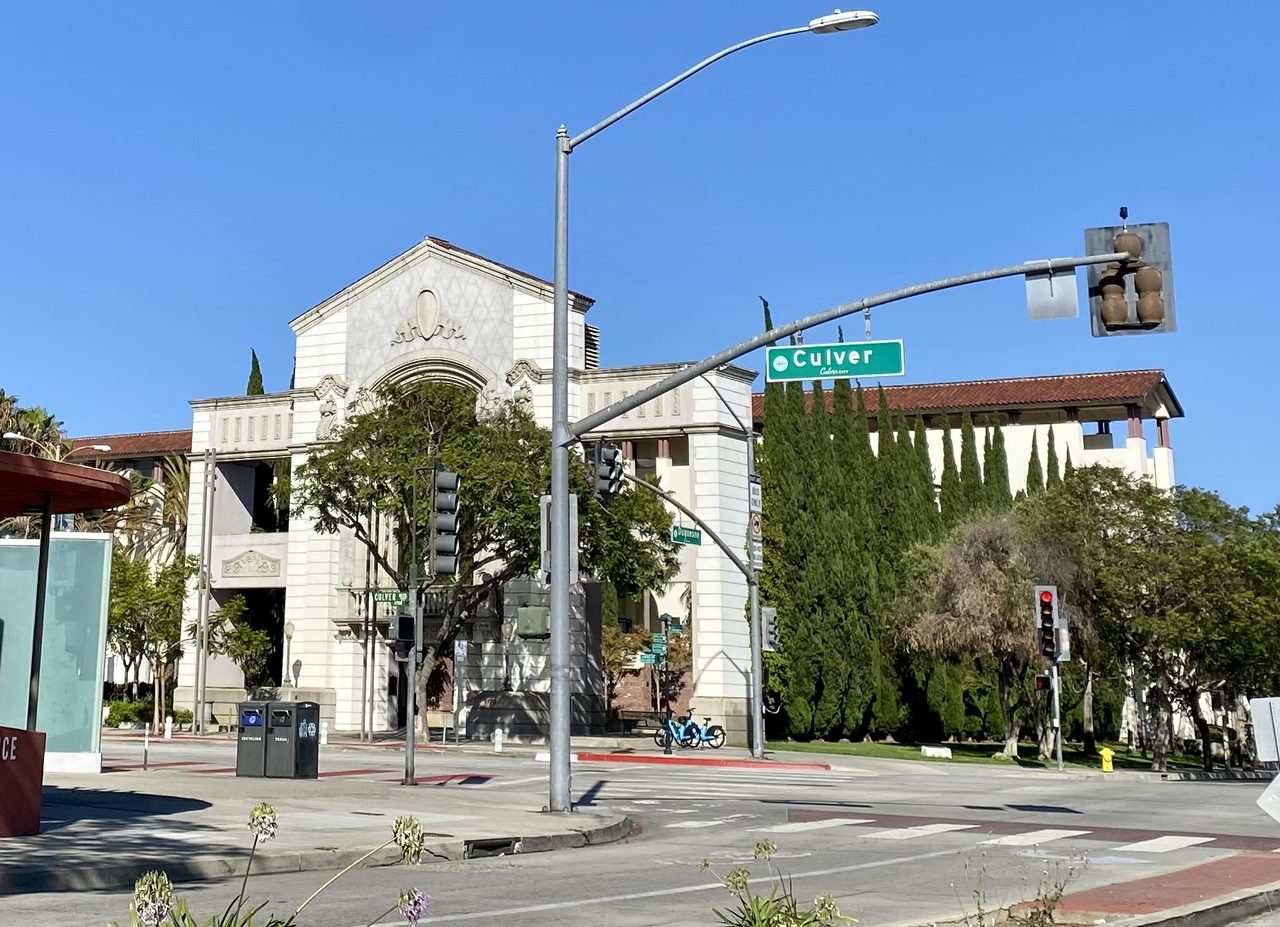 Sell Your Home Fast in Culver City, CA
 Sell Your Home Fast in Santa Clarita, CA
 Sell Your Home Fast in Marina del Rey, CA
City photo credits
- Altadena photo: Weedwhacker128 — CC0
- Glendale photo: Gedstrom — CC BY-SA 4.0
- Long Beach photo: Eric Fredericks — CC BY-SA 2.0
- Malibu photo: Mike Peel — CC BY-SA 4.0
- Pacific Palisades photo: Don Ramey Logan — CC BY-SA 4.0
- Culver City photo: Jengod — CC BY-SA 4.0
- Santa Clarita photo: Chevy111 — CC BY-SA 4.0
- Marina del Rey photo: Alexander Migl — CC BY-SA 4.0


Questions About Selling a House Before Foreclosure in Los Angeles County
Can selling my house help if I am behind on payments in Los Angeles County?
A sale may be one option, depending on the loan balance, the sale proceeds and how much time is left. If the sale price covers the payoff and the closing costs, the loan is paid in full at closing and the foreclosure ends. If you owe more than the home is worth, a short sale needs the lender's approval. Property tax is part of the math as well.
The Los Angeles County Treasurer and Tax Collector says secured property taxes are typically prorated between buyer and seller during escrow. So ask the escrow officer how your share will be handled. Before you decide, speak with your servicer and a HUD-approved housing counselor, because those agencies provide foreclosure prevention counseling free of charge. This is general information, not legal or tax advice. (see Sources: Los Angeles County Treasurer and Tax Collector: new property owner; Consumer Financial Protection Bureau: HUD-approved housing counselors)
Should I ignore calls or notices from my lender?
No. Keep records and contact your servicer promptly so you understand the current status and deadlines. California servicers must try to reach you to discuss options at least 30 days before recording a notice of default. And those conversations are where repayment plans and modifications start. Ask whether a notice of default has been recorded with the Los Angeles County Registrar-Recorder yet. Then write down who you spoke with, the date and what was said.
Open every envelope, too. A notice of sale names the trustee handling the sale, which may be a company you have not dealt with before. So an unfamiliar letter can still be the one that carries your sale date. If the calls feel like too much, a HUD-approved housing counselor can help you understand your options first. This is general information, not legal or tax advice. (see Sources: California Civil Code section 2923.5; Civil Code 2924f)
Can I ask for an offer without committing to sell?
Yes. A conversation or offer is not an obligation to sell your property. You can request an as-is offer, compare it with your other options and walk away if it does not fit. You might sign a contract while a notice of default is recorded on the home you live in. If you do, California law also gives you a period to cancel it.
When you compare offers on a house inside the City of Los Angeles, ask about one local item. The seller must give the buyer a Residential Property Report from the City's building department, and the fee is $70.85 per report. Ask each buyer who orders that report and who pays for it, and get the answer in writing. This is general information, not legal or tax advice. (see Sources: Civil Code 1695.1; Civil Code 1695.4; City of Los Angeles Department of Building and Safety: residential property report)
How long does foreclosure take in California and Los Angeles County?
It varies, but the minimums add up. A first filing generally cannot come until the loan is more than 120 days delinquent. Then at least three months must pass after the notice of default. And the notice of sale must come at least 20 days before the auction. Postponements often stretch this, so your notices and your servicer give the real dates.
A California home loan secured by a deed of trust is usually foreclosed through a trustee under Civil Code 2924, without a court case. So for a Los Angeles County home, your dates come from the trustee's notices and not from the Los Angeles Superior Court. Write each date on a calendar the day its notice arrives. This is general information, not legal or tax advice. (see Sources: 12 CFR 1024.41(f)(1), Regulation X; Civil Code 2924; Civil Code 2924f)
Can I still sell my Los Angeles County house after a notice of sale is posted?
Often, yes, if the sale can close before the auction date or the servicer agrees to postpone it. Time is short at that stage, because the notice of sale only has to be posted and published 20 days ahead. So tell any buyer the sale date on the first call. For a home of up to four units, the law also allows one 45-day postponement when the trustee receives a qualifying listing agreement.
After that, the law allows one more when the trustee receives a signed purchase agreement. Each one has to arrive at least five business days before the sale. A direct sale can close in as little as 7 days when the title and payoff are in order. But always confirm the current sale date with the trustee named on your Los Angeles County notice. This is general information, not legal or tax advice. (see Sources: Civil Code 2924f)
What does reinstating the loan mean?
Reinstating means paying the past-due payments plus the fees and costs the law allows, which brings the loan current and stops the foreclosure. In California you can usually reinstate until five business days before the trustee sale. For a Los Angeles County home, the recorded notice of default shows the amount past due when it was recorded. But that figure is only a starting point.
Ask your servicer for a written reinstatement quote, because the amount grows each month, and send the payment in a way you can track. Once the payment clears, ask for written confirmation that the loan is current and that the sale is cancelled, and keep it with your notices. This is general information, not legal or tax advice. (see Sources: Civil Code 2924c)
What is a short sale, and how does it close in Los Angeles County?
A short sale is a sale for less than the amount owed, with the lender agreeing to accept the lower payoff. It takes the lender's written approval, which can take weeks, and the lender may ask for hardship documents. It can be an option when the home is worth less than the loan, and a real estate agent or attorney can explain the process.
Once approved, it closes like any other Los Angeles County sale. The County Assessor says all properties are reassessed as of the date a change in ownership occurs. And a Preliminary Change of Ownership Report must be filed when the transfer is recorded. Because approval takes time, check that the sale date on your notice leaves room for it. This is general information, not legal or tax advice. (see Sources: Los Angeles County Assessor: change in ownership)
Will a foreclosure or a sale affect my credit?
Missed payments already affect your credit. And under federal law, most negative items, including a foreclosure, can stay on a credit report for up to seven years. Selling before the auction avoids a completed foreclosure being reported, though the late payments remain.
A HUD-approved housing counselor can explain how each option is likely to affect your credit and finances. HUD's counselor search lists approved agencies that serve Los Angeles County. Ask the counselor to compare a sale, a short sale and a completed foreclosure for your own situation before a sale date gets close. This is general information, not legal or tax advice. (see Sources: 15 U.S.C. 1681c(a), Fair Credit Reporting Act; HUD: find a HUD-approved housing counseling agency; Consumer Financial Protection Bureau: HUD-approved housing counselors)
Are you a law firm or a housing counselor?
No. Tucker Buys Houses LA is a direct home buyer. We do not give legal, tax or credit advice and we do not charge you to discuss your options. For advice about your loan, contact a HUD-approved housing counselor or a California attorney, and compare their guidance with any offer you receive.
If you live in the Los Angeles County home and a notice of default has been recorded, California's home equity sales rules apply. They say an investor's purchase contract must be in writing with the terms the law sets. And they give you a short window to cancel it. A counselor or attorney can read that contract with you before you sign. This is general information, not legal or tax advice. (see Sources: HUD: find a HUD-approved housing counseling agency; Civil Code 1695.3; Civil Code 1695.4)
What happens to my equity if I sell before the auction?
If the sale price is more than the loan payoff, any other liens and the closing costs, the difference is paid to you at closing. That is one of the main reasons owners with equity sell before a trustee sale, where the price is set at auction instead. In Los Angeles County the Registrar-Recorder collects the County's documentary transfer tax of $0.55 for each $500 of value when the deed is recorded. Inside the City of Los Angeles it also collects the City's $2.25 for each $500.
Inside the City of Los Angeles, Measure ULA also applies to sales above $5.4 million. Your purchase agreement decides who pays it. Ask the escrow officer for an estimated closing statement so you can see the numbers before you sign. This is general information, not legal or tax advice. (see Sources: Los Angeles County Registrar-Recorder/County Clerk: documentary transfer taxes; Los Angeles Office of Finance: Measure ULA)
Can I sell if I also have a second mortgage or other liens?
Usually, yes. Look at every lien on the title, such as a second mortgage, a home equity line, a tax lien or a judgment. Each one is paid from the sale proceeds at closing or must be settled with that lienholder first. The title company finds these liens in its search. If the proceeds will not cover them, a lienholder may need to agree to accept less.
Inside the City of Los Angeles, look for city charges as well. The Los Angeles Fire Department says unpaid fees and liens follow the property and not the owner on record. Liens also affect timing, because the purchase-agreement postponement only works for a price of at least the total of all recorded liens. This is general information, not legal or tax advice. (see Sources: Los Angeles Fire Department, Fire Prevention: 9A / Liens; Civil Code 2924f)
How do I start?
Call (424) 341-0837 or use the form on this page. Share the property address, your sale date if one is set and the best way to reach you. We will ask about the house and your timeline and, if a direct purchase fits, send a written offer within 24 hours. Requesting an offer does not commit you to sell. If a notice of trustee's sale has been posted on your Los Angeles County home, keep that notice nearby.
That notice is key because it sets the sale date and names the trustee, and we will ask for both on the first call. Tell us which city the house is in as well. It matters since the Registrar-Recorder lists five cities with their own transfer tax rates: Culver City, Los Angeles, Pomona, Redondo Beach and Santa Monica. This is general information, not legal or tax advice. (see Sources: Civil Code 2924f; Los Angeles County Registrar-Recorder/County Clerk: documentary transfer taxes)
Do I still owe Los Angeles County property tax while I am behind on my mortgage?
Yes. The annual secured property tax bill keeps its own schedule, whatever is happening with the loan. The first installment is due November 1 and is late after December 10. The second is due February 1 and is late after April 10, when a $10 cost is also added. Each late installment carries a 10 percent penalty.
If your loan has an impound account, ask the servicer whether it is still paying the tax. If you pay the bill yourself, check what is due on the County's Property Tax Portal. Your Assessor's Identification Number prints on the bill in the format 1234-567-890. The Assessor Portal shows the property details and the Property Tax Portal shows the billing. This is general information, not legal or tax advice. (see Sources: Los Angeles County Property Tax Portal: annual secured property tax bill; Los Angeles County Assessor: property search tool)
I rent out my Los Angeles County house and it is facing foreclosure. What about my tenants?
Start with the rules that protect tenants. Under state law, once a tenant has lived in a rental for 12 months, the owner cannot end the tenancy without just cause. The exceptions are an exempt unit or a stronger local rule. Parts of Los Angeles County have stronger local rules. In the City of Los Angeles, the Rent Stabilization Ordinance applies to rental property built on or before October 1, 1978.
For unincorporated areas, the County says its Temporary Rent Stabilization Ordinance took effect December 20, 2018. From May 16, 2019, it extended just-cause protections to most rental units there. Tell any buyer about the tenants on the first call, and talk with a landlord-tenant attorney before you serve any notice. This is general information, not legal or tax advice. (see Sources: Civil Code 1946.2; Los Angeles Housing Department: rent control property overview; Los Angeles County Department of Consumer and Business Affairs: Rent Stabilization Ordinance information for property owners)
If I sell before foreclosure and buy a smaller home, can I keep my Los Angeles County tax base?
Sometimes. Under Proposition 19, a homeowner who is over 55, severely disabled, or a victim of a wildfire or other disaster has an option. That owner can move the lower assessed value of a primary home to a newly bought or built replacement principal residence anywhere in California. The Los Angeles County Assessor says this can be done up to three times, or once per disaster.
That matters if a sale before the auction leaves you enough to buy again. Proposition 13 explains why the old value is worth keeping. The tax is capped at 1 percent of assessed value. And the assessed value rises at most 2 percent a year until a change in ownership. Ask the Assessor about the claim form before you buy. This is general information, not legal or tax advice. (see Sources: Los Angeles County Assessor: Proposition 19; California Constitution Article XIII A (Proposition 13))
The short version
Short on time? Here is the quick answer for a Los Angeles County homeowner who is behind on the mortgage.
- Open every notice. Your notices and your servicer set the real dates. A buyer cannot tell you your deadlines.
- The law builds in waiting periods. The first foreclosure filing generally cannot come until the loan is more than 120 days late [source]. Then at least three months must pass after a notice of default before a notice of sale [source].
- Free help exists. HUD-approved housing counseling agencies provide foreclosure prevention counseling free of charge [source].
- Catching up has a cutoff. You can usually reinstate the loan until five business days before the trustee sale [source].
- Selling is one option of several. Catching up, a repayment plan, a loan modification, a listing, a short sale and a direct sale each fit a different situation.
- Never pay to stop a foreclosure. Walk away from anyone who wants an upfront fee or asks you to sign over your deed.
- Want a cash offer to compare? We send a no-obligation cash offer within 24 hours. Call (424) 341-0837.
Your foreclosure timeline, step by step
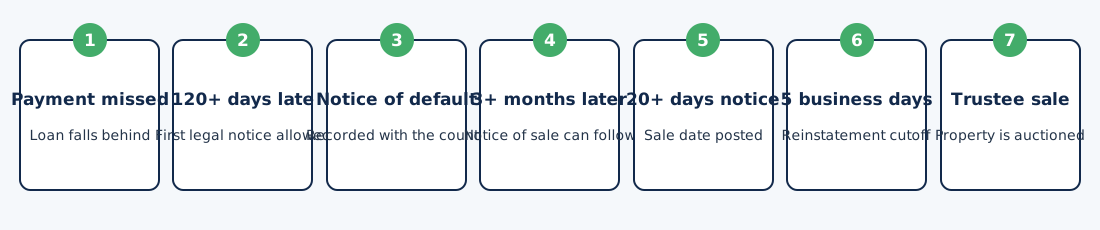
A California foreclosure follows a set order, and the law sets a minimum wait at each step.
Open and keep every notice from your servicer. Ask your servicer for the current status, the amount needed to reinstate or pay off the loan, and the deadlines that apply. Do not rely on a buyer alone for deadline information.
A California home loan secured by a deed of trust is usually foreclosed out of court, through a trustee. The minimum waits come in this order.
Minimum waiting periods in a California foreclosure
- First filing: more than 120 days late. A servicer generally cannot make the first foreclosure filing until the loan is more than 120 days delinquent [source].
- Contact attempt: 30 days before a notice of default. The servicer must try to contact you to discuss options at least 30 days before it records a notice of default [source].
- Notice of default: at least three months. After the notice of default is recorded, at least three months must pass before a notice of sale can be posted [source].
- Notice of sale: at least 20 days. The notice of sale must be posted and published at least 20 days before the sale date [source].
- Reinstatement cutoff: five business days. You can usually reinstate the loan by paying the past-due amount and allowed costs until five business days before the sale [source].
Mark your own dates
These are minimums, not your dates. Mark each date from your own notices on a calendar, and check it again after every call with the servicer.
What each foreclosure notice means
Each notice tells you how far along the foreclosure is and how much time is left.
- Late notices and calls. The loan is behind, but no foreclosure has started. This is when the most options are open.
- Notice of default. Recorded with the Los Angeles County Registrar-Recorder. It states how much is past due and starts the three-month period.
- Notice of trustee's sale. Sets the date, time and place of the auction. Reinstatement closes five business days before it.
- Trustee sale. The home is sold at auction. Options after this point are very limited.
Postponements are common, so the sale date on a notice may move. Always confirm the current date with your servicer or the trustee named on the notice.
The 45-day postponements
California also gives owners of homes with up to four units two postponements, used in order. Both come from Civil Code 2924f(e) [source]. The first rests on a listing agreement with a California real estate broker. The second rests on a signed purchase agreement and can only follow the first. Here is how they work.
Postponement by listing agreement
- A listing agreement can move the sale back 45 days. If the trustee receives a listing agreement with a California real estate broker to market the home publicly, the sale is pushed back 45 days. The reinstatement deadline also moves with it [source].
- That listing postponement can be used only once. Ask the trustee to confirm the new sale date in writing, and write it on your calendar. Then ask your servicer for a new written reinstatement quote.
Sending it to the trustee
- Delivery and timing are strict. It must be sent by tracked certified or overnight mail and reach the trustee at least five business days before the sale.
Postponement by purchase agreement
- A signed purchase agreement can add time after that. It works only if the sale was already postponed that way. The purchase agreement must be fully signed and for at least the total of all recorded liens. It is sent the same way at least five business days before the new date. That pushes the sale to at least 45 days after the trustee receives it [source].
Before you use either postponement
Both steps depend on paperwork reaching the right trustee in time. Your notice of trustee's sale names the trustee and sets the sale date, so start from that notice. Count back five business days from the sale date to find the last day your papers can arrive.
Who to ask first
Ask an attorney or housing counselor before relying on either step. HUD's counselor search lists approved agencies [source]. Bring your notice and any listing or purchase agreement so the dates can be checked together. Ask which papers must reach the trustee, by what date, and who will send them. Keep a copy of everything that goes out, along with its tracking number.
General information only
This is general information, not legal or tax advice. The postponement rules above are a short summary of Civil Code 2924f(e). Read the full section through its link in the Sources list below, and confirm every date with the trustee named on your notice.
Compare every workable option before you decide
Selling is only one way out, so line it up against the others.
Depending on your circumstances, options can include catching up, a repayment arrangement, a loan-workout conversation, listing or selling directly. A HUD-approved housing counselor or California attorney can help you understand choices beyond a property sale [source]. HUD-approved housing counseling agencies provide foreclosure prevention counseling free of charge [source].
Options to compare
The six options below fall into two groups: three ways to keep the home and three ways to sell it. Reinstatement, for example, has a cutoff five business days before the trustee sale [source]. A home sale has to close before the auction date, unless the trustee sale is postponed.
Ways to keep the home
- Reinstatement: pay the past-due amount and keep the home.
- Repayment plan or forbearance: spread the shortfall over time or pause payments while you recover.
- Loan modification: change the loan's terms so the payment fits your income.
Ways to sell the house
- List the home: sell on the open market if there is time for showings and a buyer's loan.
- Short sale: sell for less than you owe with the lender's approval.
- Direct sale: sell as is to a buyer on a fixed date, which can work when time is short. If repairs are part of the problem, read how to sell a house as is in Los Angeles.
Weigh them side by side
For each option, write down what it costs, how long it takes and whether you keep the home. Seeing them side by side makes the choice clearer.
Questions to ask your servicer
Most options begin with one phone call to your servicer.
That call can feel like the hardest step. Keep a notebook by the phone and write down the date, the name of the person you spoke with and what they said.
What to ask on the call
- The amount behind: What is the total past-due amount today, and what will it be next month?
- The stage: Has a notice of default been recorded, and is a sale date set?
- Workout options: Which workout options can I apply for, and what documents do you need?
- A pause: Will the foreclosure pause while a complete application is reviewed?
- Written figures: Can you send me a written reinstatement quote and a written payoff statement?
- One contact: Who is my single point of contact, and how do I reach them directly?
After the call
Ask for every answer that affects a deadline in writing, and send documents in a way you can track. File your notes and the servicer's letters together in date order. California requires the servicer to try to contact you to discuss options at least 30 days before it records a notice of default [source]. A dated call log shows what was offered and when.
Your rights if you sell during foreclosure
California adds extra protection when a homeowner sells during foreclosure.
The rules come from California's Home Equity Sales Contracts Act. This is general information, not legal or tax advice.
- Who it covers. The act protects owners who live in a one- to four-unit home with a recorded notice of default and sell it to an investor [source].
- A written contract. The contract must be in writing with the terms the law requires [source].
- A right to cancel. You can cancel it until midnight of the fifth business day after you sign, or until 8 a.m. on the day of the trustee sale, whichever comes first [source].
Before you sign anything
- Read every document before you sign it.
- Keep your deed. Never sign a deed or transfer the home to anyone who promises to stop a foreclosure in exchange for an upfront fee.
- Take your time. A legitimate buyer will give you time to review the contract with an advisor.
Documents to gather now
One folder of papers will speed up every option on this page.
Whatever you decide, the same papers will be needed. Gathering them early saves days when time is short.
What goes in your foreclosure folder
- Notices: every notice from your servicer, its attorney or the trustee, in date order.
- Latest mortgage statement: the one with the servicer's phone number and your loan number.
- Reinstatement and payoff figures: a written reinstatement quote and a written payoff statement, requested from the servicer.
- Other debts on the house: statements for any second mortgage, home equity line, tax lien or association dues.
- Title papers: your deed or title information, and the names of everyone on title.
If the borrower has died
If the person named on the loan has died and the house passed to you, some steps and papers change. Read how to sell an inherited house in Los Angeles before you call the servicer.
Warning signs of a foreclosure scam
Owners facing foreclosure are a common target for fraud, so slow down when someone pushes.
Be cautious with anyone who does any of the following.
- Wants money first: asks for an upfront fee to stop or delay the foreclosure.
- Cuts out your servicer: tells you to stop talking to your servicer or to send your payments to them instead.
- Asks for your deed: wants you to sign over the deed so you can rent the home back and buy it later.
- Rushes you: pressures you to sign the same day, or will not let an attorney or counselor review the papers.
- Promises too much: says that a sale date will certainly be cancelled.
If something feels wrong, stop and call a HUD-approved housing counselor before you sign anything.
How a direct sale works when a sale date is set
A direct sale follows five plain steps, and it starts with your sale date. Every step is planned back from the date on your notice of trustee's sale. That notice only has to be posted and published 20 days before the sale [source], so bring it to the first call.
From first call to closing
- Call with your sale date. Tell us the date on your notice so we know how much time there is.
- We review the house as it is. No repairs, cleaning or showings.
- You get a written offer within 24 hours. Compare it with your other options; there is no obligation.
- Escrow orders the payoff. The title company confirms the amount the servicer needs and any other liens.
- Closing pays off the loan. A sale can close in as little as 7 days when title and payoff are in order. Then any money left after the payoff and costs is paid to you.
Who handles the money
The sale closes through a title and escrow company. So the servicer is paid from the sale money at closing, and you get a closing statement that shows every number.
When selling is not the best fit
Sometimes the better answer is to keep the house or to list it.
- You want to stay and can afford the payment again: a reinstatement, repayment plan or loan modification may be better than any sale.
- You have plenty of equity and several months: listing with an agent may bring a higher price.
- You are not sure yet: a HUD-approved housing counselor can help you understand your choices before a sale date is set.
A direct sale is one option to compare, not the answer for every owner.

If you consider a direct sale
A direct sale only helps when the numbers work, so check them first.
Share the property condition and your deadline. We can tell you whether a direct offer is practical. But you remain in control of the decision and should not sign anything you do not understand.
A sale helps only if one of these is true
- The price covers the debts: the loan payoff, any other liens and the costs of closing.
- The lender agrees to accept less: that is a short sale, and it needs the lender's approval.
Next steps
Ask your servicer for a written payoff statement so the numbers can be checked. We send a written offer within 24 hours of reviewing the house. A sale can close in as little as 7 days when the title and payoff are in order. That speed can matter when a sale date is close.
Guides to read next
Learn how a direct cash sale works. Or read How Mortgage Payoff Works in a California Home Sale and How to Review a California Seller Closing Statement.
Sources
- 12 CFR 1024.41(f)(1), Regulation X (no first foreclosure notice before 120 days delinquent)
- Civil Code 2923.5 (California Legislative Information)
- Civil Code 2924 (California Legislative Information)
- Civil Code 2924f (California Legislative Information)
- Civil Code 2924c (California Legislative Information)
- Civil Code 2924f(e) (California Legislative Information)
- Civil Code 1695.1 (California Legislative Information)
- Civil Code 1695.3 (California Legislative Information)
- Civil Code 1695.4 (California Legislative Information)
- HUD: find a HUD-approved housing counseling agency
- Consumer Financial Protection Bureau: HUD-approved housing counselors (foreclosure prevention counseling is free of charge)
- 15 U.S.C. 1681c(a), Fair Credit Reporting Act (most negative items reported no more than seven years)
- Los Angeles County Registrar-Recorder/County Clerk: documentary transfer taxes
- Los Angeles Office of Finance: Measure ULA
- Los Angeles County Treasurer and Tax Collector: new property owner (escrow proration)
- City of Los Angeles Department of Building and Safety: residential property report
- Los Angeles County Assessor: change in ownership
- Los Angeles Fire Department, Fire Prevention: 9A / Liens
- Los Angeles County Property Tax Portal: annual secured property tax bill
- Los Angeles County Assessor: property search tool
- Civil Code 1946.2 (California Legislative Information)
- Los Angeles Housing Department: rent control property overview
- Los Angeles County Department of Consumer and Business Affairs: Rent Stabilization Ordinance information for property owners
- Los Angeles County Assessor: Proposition 19
- California Constitution Article XIII A (Proposition 13)
Tucker Buys Houses LA is a direct home buyer, not a law firm, lender or housing counselor. This page is general information, not legal, tax or financial advice.
Contact Us
(424) 341-0837
Email: [email protected]
Since 2016
Service Hours
Monday - Friday: Open 24 Hours
Saturday: Open 24 Hours
Sunday: Open 24 Hours
2026 | All Rights Reserved
Privacy Policy | Terms of Service | Site Map
Contact Us
Service Hours
Open 24 Hours
7 Days Per Week